 creatify
TikTok Shop Creator Networks: How They Work and How to Judge One (2026)
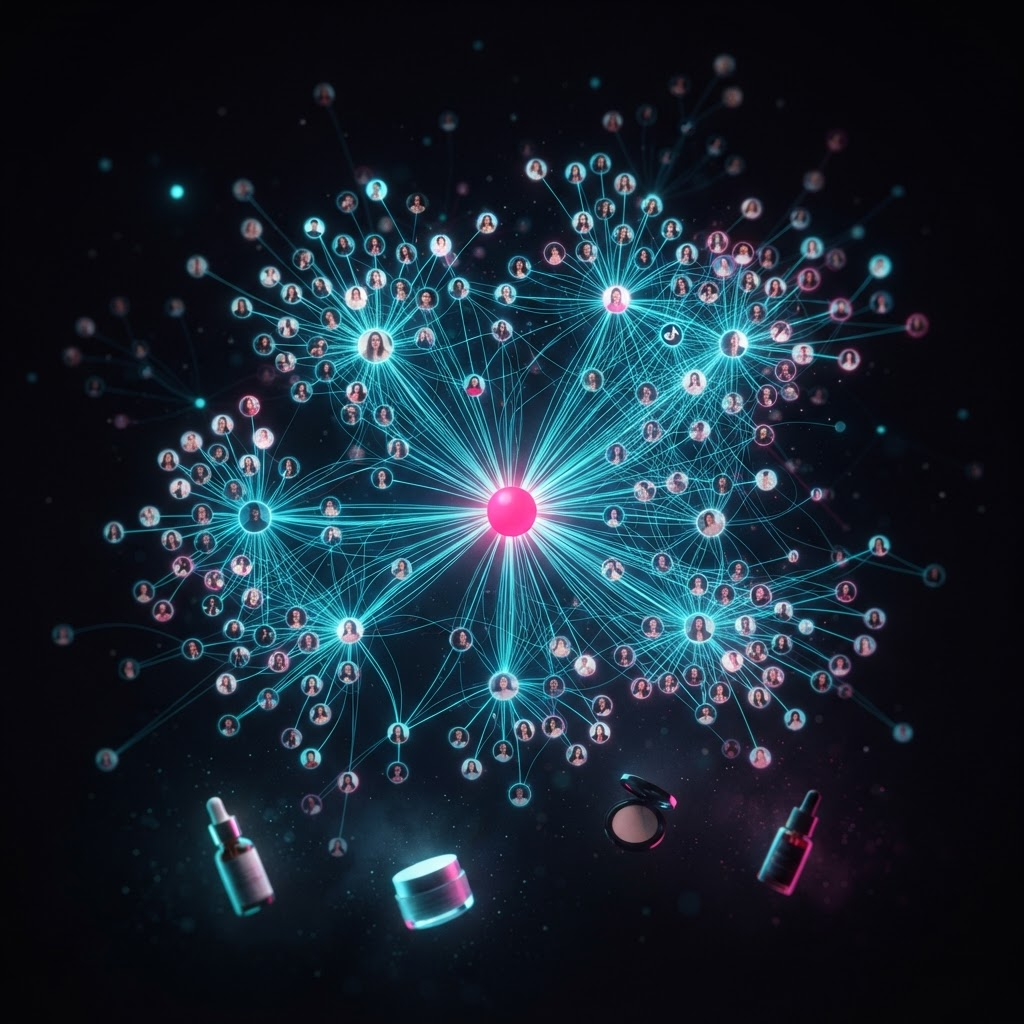
A TikTok Shop creator network is an organized, ongoing pool of vetted creators that a brand or agency can activate on demand to promote specific products. The word doing the work in that sentence is ongoing. A list of creator handles is not a network. A network is a set of maintained relationships — with trust, history, response rates, and payout track record behind them — which is precisely what determines whether your next SKU launch gets 8 posts or 80.
- A network is relationships, not a roster. The measurable difference shows up in response rate and time-to-post.
- Five distinct network types exist, from TikTok's native Open Collaboration to closed agency communities. They are not substitutes.
- Open vs Targeted Collaboration are different economic instruments — the Target rate overrides your Open rate, which brands routinely misconfigure.
- Judge a network on six metrics, starting with 30-day active rate and category density. Roster size is a vanity number.
- Building your own network takes 12–18 months. Buying access is usually the right call unless creator management is a core competency.
Why networks became the unit of competition
Beauty and personal care is the largest TikTok Shop category in the US — roughly $2.7 billion in 2025 and about $2.08 billion in the first half of 2026, climbing to nearly 23% of all TikTok Shop US sales by July 2026. When a category grows that fast, creator attention becomes the scarce resource, and scarce resources get allocated by relationship rather than by broadcast.
- $2.7BUS beauty & personal care GMV, 2025
- ~23%Beauty share of TikTok Shop US sales, July 2026
- 12–18moRealistic time to build an in-house network from zero
- 14 daysGMV Max learning window fed by creator content
There is a second forcing function. GMV Max, TikTok's automated shop-sales engine, distributes budget across your eligible creator, affiliate, and Spark content and cannot scale without a steady stream of authorized creator videos. Your creator network is no longer just an organic channel — it is the input that determines whether your paid engine has anything to optimize.
Reframe: stop thinking of a creator network as a distribution list and start thinking of it as inventory. Content inventory feeds ads. Relationship inventory determines how fast you can restock.
The five types of TikTok Shop creator networks
1. Open Collaboration (TikTok's native affiliate pool)
You list a product in Seller Center with a public commission rate, and any eligible creator can self-serve, generate an affiliate link, and start posting. It is permissionless and infinitely scalable in theory.
Reality: excellent for discovery and long-tail volume; poor for control. You cannot dictate who picks up the product, what they say, or when they post. Beauty brands regularly discover unapproved efficacy claims here.
2. Targeted Collaboration (invite-based)
You select specific creators and send invitations, typically bundled with free samples and sometimes a flat fee alongside commission. Crucially, the Target rate overrides your Open rate for those creators.
Reality: real selection control, but you own the entire workflow — shortlisting, outreach, negotiation, sample logistics, chasing, and quality review. Acceptance rates from cold invitations are typically low.
3. TikTok Creator Marketplace
TikTok's official discovery and booking surface for brand partnerships, with audience data and performance history. See our deeper breakdown of the Creator Marketplace trade-offs.
Reality: strong for research and vetting. Still a marketplace: it sells access, not delivery.
4. Agency and TAP-managed networks
A certified TAP agency or managed creator agency maintains its own recruited, vetted, and continuously engaged creator pool. Because the agency has an existing relationship and payment history with each creator, briefs move fast and acceptance rates are materially higher.
Reality: the fastest path to directed volume. Quality varies enormously between agencies, which is exactly why the metrics in the next section matter.
5. Owned brand communities
Some brands build private creator communities — Discord servers, ambassador programs, tiered commission ladders. Creator Circle is an example operated at agency scale, with 12,800+ creators, 10,000+ active, and more than $100M paid out.
Reality: the highest ceiling and the highest cost. Community management is a genuine operational discipline, not a side project for your social coordinator.
Network types compared
| Network type | Selection control | Speed to volume | Content quality control | Effort on your team |
|---|---|---|---|---|
| Open Collaboration | None | Slow, unpredictable | Low | Low |
| Targeted Collaboration | High | Slow | Medium | Very high |
| Creator Marketplace | High | Medium | Medium | High |
| Agency / TAP network | High | Fast | High | Low |
| Owned community | Very high | Fast once mature | Very high | Very high |
Open vs Targeted Collaboration: the mechanics brands get wrong
These two instruments are frequently configured as if they were one setting. They are not.
| Open Collaboration | Targeted Collaboration | |
|---|---|---|
| Who can promote | Any eligible creator | Only invited creators |
| Commission | Single public rate | Custom rate that overrides Open |
| Samples | Creator requests | Usually brand-provided |
| Flat fees | Not available | Often available |
| Best use | Long-tail discovery | Named creators, launch windows |
Common and expensive mistake: setting a high Open rate to attract volume, then inviting your best creators via Targeted Collaboration at a lower negotiated rate. The override applies, your top performers earn less than the long tail, and they quietly stop posting.
Six metrics that reveal whether a network is real
When an agency pitches you a network, roster size is the least informative number they can give you. Ask for these instead.
- 30-day active rate. What percentage of the network published commerce content in the last 30 days? A large inactive roster is a mailing list.
- Category density. How many active creators post specifically in beauty, skincare, or supplements? Cross-category totals hide thin coverage.
- Brief acceptance rate. Of creators invited to a campaign, what share actually accept? This is the single cleanest proxy for relationship strength.
- Median time-to-post. Days from brief to live content. This determines whether you can hit a launch window.
- Repeat-post rate. Share of creators who post a second and third time for the same brand. Repeat posting is where GMV compounds.
- Cumulative payouts. Money actually paid to creators. Payment history is the most honest evidence a network is maintained rather than scraped.
Ask any prospective partner for those six numbers. The speed and specificity of the answer will tell you more than the deck will.
The network flywheel — and why it compounds
Healthy creator networks improve with use, which is why incumbents are hard to displace:
- Creators earn reliably, so they respond faster to the next brief.
- Faster response produces more content variety, giving GMV Max more to optimize across.
- Better paid performance funds higher commissions and flat fees.
- Higher earnings attract stronger creators and increase repeat-post rate.
- More winning angles get identified, which raises conversion for everyone in the network.
The corollary is uncomfortable: a network that has not been paying creators consistently is not a network you can borrow speed from, no matter how many handles are in the spreadsheet.
Build your own or buy access?
- Creator management is a core strategic competency
- You can staff dedicated community and ops roles
- You have 12–18 months before you need scale
- Your catalog is broad enough to keep creators earning year-round
- You have launch windows to hit this quarter
- Your team is already at capacity
- You need category-specific creators immediately
- GMV Max is starved for authorized creative
Most $30M+ DTC brands are better served buying access first and building selectively later — typically by converting the top performers discovered through an agency program into a long-term owned ambassador tier.
Four ways creator network programs fail
- Treating volume as the goal. Fifty low-intent posts from creators with no category fit will underperform twelve well-briefed ones.
- No claim-review workflow. In skincare and supplements, unmanaged Open Collaboration is a compliance exposure, not just a quality issue.
- One-and-done activations. Programs that never earn a second post never reach the compounding part of the curve.
- Disconnecting creators from ads. If nobody is collecting authorization codes, your best organic content can never be amplified through Spark Ads or fed into GMV Max.
Where this fits in your partner decision
Network quality is the main thing separating agencies that look identical on paper. If you are actively evaluating partners, pair this with our ranked breakdown of the best TikTok Shop creator agencies and, if certification matters to your procurement process, our guide to TAP versus TSP designations.
Frequently asked questions
What is a TikTok Shop creator network?
A TikTok Shop creator network is an organized, continuously maintained pool of vetted creators that a brand or agency can activate to promote specific products. Unlike a static creator list, a network has ongoing relationships, established payment history, and measurable response rates, which is what allows briefs to convert into published content quickly and predictably.
What is the difference between Open Collaboration and Targeted Collaboration?
Open Collaboration lets any eligible creator self-serve your product at a single public commission rate, offering scale but no selection or content control. Targeted Collaboration is invite-based: you choose specific creators, usually provide samples, and can offer flat fees. The Targeted rate overrides the Open rate for invited creators, so the two must be configured together to avoid underpaying your best performers.
How do I evaluate the quality of a creator network?
Judge it on six metrics rather than roster size: 30-day active rate, category density in your vertical, brief acceptance rate, median time-to-post, repeat-post rate, and cumulative creator payouts. Acceptance rate and payout history are the strongest indicators that relationships are genuinely maintained.
Should I build my own creator network or use an agency network?
Building an in-house network realistically takes 12 to 18 months and requires dedicated community and operations staff. Using an agency network gives immediate access to category-specific creators and is the better choice when you have launch windows this quarter or when GMV Max needs authorized creative now. Many brands buy access first, then convert top performers into an owned ambassador tier.
How do creator networks affect GMV Max performance?
GMV Max automatically allocates budget across eligible creator, affiliate, and Spark content and needs sufficient authorized creator videos to scale past its roughly 14-day learning window. A creator network determines that supply. Without consistent authorized content and creative variety, GMV Max has little to optimize across and paid performance plateaus.
How many creators does a TikTok Shop program need?
There is no universal number, but depth in your category matters far more than total headcount. A concentrated group of well-briefed, category-relevant creators posting repeatedly will typically outperform a much larger pool of one-time posters, because repeat posting is where GMV and creative learning compound.
Are TikTok Shop creator networks the same as MCNs?
Not exactly. An MCN traditionally manages creators' overall careers and revenue, while a TikTok Shop creator network is organized around commerce activation for brands. Agency-run commerce networks and TAP agencies focus on recruiting, briefing, and directing creators toward specific product promotions and affiliate performance rather than managing talent representation broadly.
Borrow a network that already has momentum
Creator Circle is a 12,800+ creator network with 10,000+ active members and $100M+ paid out — built for DTC beauty, skincare, and supplement brands that need directed creator volume, not another list.
See if your brand qualifiesTikTok's #1-ranked Creator Matchmaking Partner